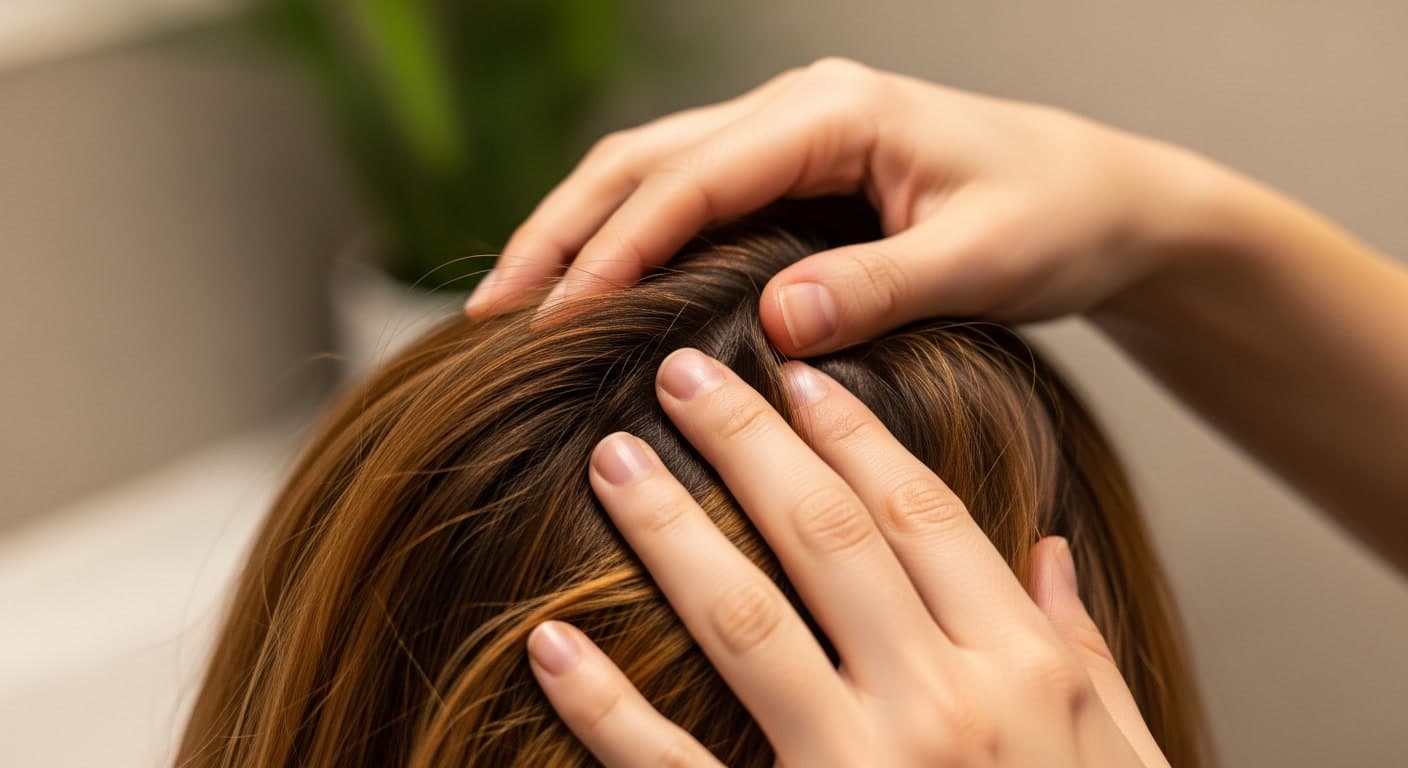


Scalp massage for hair growth probably works for some people, but the evidence is early-stage and no one can tell you in advance whether you will be one of them. Two small studies show measurable thickness and density improvements after months of daily massage. A handful of dermatologists call the data “inconclusive.” Both sides are right. The studies are real but tiny, and the only way to settle the question for your own head is to run a structured tracking protocol and measure what happens.
TL;DR
- A 2016 study of 9 men found 24 weeks of 4-minute daily scalp massage increased hair thickness.
- A 2019 survey of 340 participants reported 68.9% saw stabilization or regrowth after an average of 36.3 total hours of massage.
- The proposed mechanism is mechanical stretching of dermal papilla cells, not just increased blood flow.
- No placebo-controlled RCT exists yet. UCLA Health calls the evidence “inconclusive.”
- Track density scores for at least 24 weeks before deciding if it works for you.
Important
This article is educational and not medical advice. If you are worried about sudden shedding, scalp symptoms, or side effects, talk to a licensed clinician.
What the research actually shows
The most cited study is a 2016 trial published in ePlasty (PMC4740347). Nine healthy Japanese men received a standardized 4-minute scalp massage every day for 24 weeks. At the end of the study, hair thickness had increased significantly compared to baseline. The researchers also observed changes in gene expression related to the hair cycle and mechanical stress pathways.
A larger 2019 survey study (PMC6380978) recruited 340 participants who practiced scalp massage for hair loss. Of those, 68.9% reported hair stabilization or regrowth. The median routine was 11 to 20 minutes per day over a mean duration of 7.4 months, totaling approximately 36.3 hours of massage effort. Participants who massaged for longer daily durations and longer total durations reported better outcomes.
Both studies have significant limitations. The 2016 trial had only 9 participants and no control group. The 2019 study relied entirely on self-reported outcomes with no objective measurement. UCLA Health has noted that the evidence for scalp massage and hair growth remains “inconclusive” due to small sample sizes and the absence of a placebo-controlled randomized trial.
The only way to know if scalp massage works for you specifically is to track density and thickness scores. BaldingAI gives you objective week-over-week data instead of guessing in the mirror. Without measurement, you are relying on the same self-reported perception that limits the existing research.
How scalp massage may actually work
The popular explanation is “increased blood flow.” That is not wrong, but it is incomplete. The 2016 study found that the primary mechanism appears to be mechanical stretching forces applied directly to dermal papilla cells at the base of the hair follicle.
Dermal papilla cells regulate the hair growth cycle. When these cells are subjected to repeated mechanical stress, gene expression shifts toward pathways associated with hair thickness and cycle activity. The researchers documented upregulation of genes linked to the anagen (growth) phase. Under normal conditions, about 85% of scalp hairs are in anagen at any given time. Anything that extends anagen or recruits resting follicles back into it could theoretically improve density.
There is also a structural angle. During catagen (the regression phase), a hair follicle loses roughly one-sixth of its diameter. If mechanical stimulation can delay or reduce that regression, follicles maintain more of their thickness through the cycle. This is speculative based on the gene expression data, but it aligns with the thickness increases observed in the 2016 trial.
The right technique
The 2016 study used a standardized protocol: 4 minutes per day, applied with a mechanical massage device. The 2019 survey showed that participants who massaged for 11 to 20 minutes daily reported the best results. A reasonable starting point is 4 minutes minimum, with the option to extend to 10 or 15 minutes if you can sustain it daily.
- Use your fingertips, not your nails. Press firmly enough to move the scalp against the skull. You should see the skin shifting under your fingers.
- Cover all zones: hairline, temples, crown, and vertex. Spend roughly equal time on each area.
- Do not pull the hair. The goal is compression and stretching of the skin, not traction on the follicles. Pulling can cause traction alopecia, which is the opposite of what you want.
- Be consistent. The studies showing results involved daily practice over months. Twice a week will not replicate the mechanical stress stimulus described in the research.
- Log your sessions. Track duration, pressure level, and any scalp reactions. If you skip a week, note it. Gaps in your routine are gaps in your data.
What scalp massage cannot do
Scalp massage does not block DHT. If your hair loss is driven by androgenetic alopecia, DHT is miniaturizing your follicles through a hormonal pathway that mechanical stimulation does not address. No amount of massage will inhibit 5-alpha reductase or reduce androgen receptor sensitivity.
This means scalp massage is not a replacement for medical treatments like finasteride or minoxidil if you have pattern hair loss. It may be a useful addition to a treatment stack, but expecting it to reverse significant miniaturization on its own is not supported by the current evidence. Think of it as a potential complementary habit, not a standalone solution.
It also will not regrow hair from follicles that are already fully miniaturized or scarred. The 2016 study measured thickness changes in existing hairs, not the creation of new follicles. If an area is already slick, massage alone is unlikely to bring it back.
How to track whether scalp massage is working
The 2016 study ran for 24 weeks before measuring results. That is your minimum tracking window. Here is a practical protocol:
- Week 0: set a baseline. Take guided photos of your hairline, temples, crown, and part-line density tracking zone. Use BaldingAI to get your initial density and thickness scores. These numbers are your reference point for everything.
- Weeks 1 through 12: build the habit. Massage daily. Take weekly scan photos using the same setup every time: same room, same lighting, same hair state. Review your photo tracking frequency to avoid burnout or over-analysis.
- Weeks 12 through 24: look for trends. Compare your month 3 scores to baseline, then month 4, 5, and 6. You are looking for a directional change in density or thickness scores, not a single good photo.
- Week 24: make a decision. If scores are trending up or stable, continue. If they are flat or declining despite consistent daily massage, the intervention is probably not producing a measurable effect for you. Discuss next steps with a dermatologist.
The critical rule: do not stack changes. If you start scalp massage and minoxidil in the same week, you will never know which one is responsible for any change. Pick one variable. Run it for 24 weeks. Measure. Then decide whether to add something else. For a similar approach applied to a different treatment, see the microneedling tracking protocol.
Common questions
Can scalp massage cause hair loss?
It can if you are pulling the hair rather than pressing the scalp. Traction on the follicle from gripping or tugging can lead to traction alopecia over time. The correct technique uses fingertip pads pressing into the scalp and moving the skin, not grabbing or yanking the hair itself. If you notice increased shedding in the first two weeks, monitor it closely but do not panic. Some initial shedding of telogen hairs from mechanical disruption is plausible and should stabilize.
Should I use a massage device or my hands?
The 2016 study used a mechanical device (a scalp massager). The 2019 survey included participants using hands, brushes, and devices, with no clear winner reported across methods. What matters more than the tool is consistent pressure, daily frequency, and covering all zones. If a device helps you maintain the habit, use it. If your fingertips feel more controlled, use those. Track your method so you know what you actually did if results show up.
How long before I see results from scalp massage?
The 2016 study measured changes at 24 weeks (about 6 months). The 2019 survey participants reported improvements after a mean of 7.4 months. Expect to commit to at least 24 weeks of daily practice before you have enough data to draw any conclusion. Hair grows slowly. Changes in thickness and density are not visible to the eye on a week-to-week basis, which is exactly why objective score tracking matters more than mirror checks.
Next step
Pick a start date. Take your baseline photos and get your initial density scores. Set a daily reminder for your 4-minute massage. Then do not touch the data for 12 weeks. At week 12, compare your scores to baseline. At week 24, make a real decision based on real numbers.
Background reading: Koyama et al. 2016, Standardized Scalp Massage Results in Increased Hair Thickness (PMC4740347), English & Barazesh 2019, Self-Assessments of Standardized Scalp Massages for Androgenic Alopecia (PMC6380978).