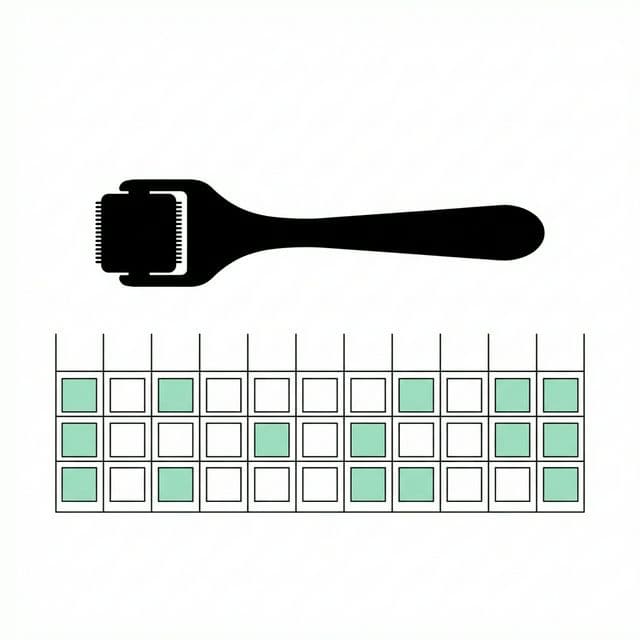
Microneedling content online is full of “it worked for me” stories and dramatic before-and-after photos taken under completely different lighting. The tracking-first way to approach microneedling is is a structured 12-week plan with consistent photos, simple logs, and honest window comparisons so you can tell whether something is actually changing without getting fooled by hair length, lighting, styling, or wishful thinking.
TL;DR
- Capture baseline photos before your first session.
- Track zone photos weekly: hairline, temples, crown.
- Log session details: frequency, device, depth, and any irritation.
- Compare baseline vs month 1 vs month 2 vs month 3, not individual photos.
- Do not stack changes. One variable at a time.
Important
This article is educational and not medical advice. If you are worried about sudden shedding, scalp symptoms, or side effects, talk to a licensed clinician.
How does microneedling work for hair loss?
Microneedling works by creating tiny controlled punctures in the scalp that trigger a wound healing response, potentially stimulating hair follicle activity and improving absorption of topical treatments like minoxidil. Also called dermarolling or collagen induction therapy, it creates tiny controlled punctures in the scalp using a dermaroller, dermastamp, or automated pen device. The theory is that these micro-injuries trigger a wound healing response that may stimulate hair follicle activity, increase blood flow, and improve the absorption of topical treatments like minoxidil.
Several studies have shown that microneedling combined with minoxidil may produce better results than minoxidil alone, though the evidence is still evolving. As a standalone treatment, the data is more limited. This is exactly why tracking matters: you need your own data to know whether it is working for you.
What device and needle depth should you use for scalp microneedling?
Most hair loss studies use needle depths of 0.5mm to 1.5mm, with pen devices or dermastamps generally preferred over rollers because the needles enter perpendicular to the skin. Microneedling devices vary significantly. Dermarollers use a barrel with needles that roll across the scalp. Dermastamps and pen devices stamp vertically, which some clinicians prefer for scalp use because the needles enter and exit perpendicular to the skin rather than at an angle.
Needle depth for hair loss studies typically ranges from 0.5mm to 1.5mm. Shallower depths (0.25mm) are generally considered insufficient for hair stimulation, while deeper settings (1.5mm+) increase the risk of scarring or damage, especially on the scalp. Using deeply. Whatever depth you use, log it. If you change depth mid-protocol, you have introduced a variable that makes your results harder to interpret.
What does a 12-week microneedling tracking protocol look like?
A 12-week protocol starts with baseline photos on day 0, builds consistent capture habits in month 1, looks for early signals in month 2, and makes the first meaningful comparison at month 3. Keep it simple and repeatable:
Weekly protocol
- Baseline (day 0): full zone photos before your first session. This is your reference for everything.
- Weeks 1-4 (month 1): focus on building consistent habits. Photos every week, same setup. Log session details.
- Weeks 5-8 (month 2): compare month 1 window to month 2 window. Look for early signals, but do not overreact.
- Weeks 9-12 (month 3): first meaningful comparison point. Compare baseline, month 1, month 2, and month 3 windows.
What should you log so microneedling outcomes are interpretable?
- Session frequency: how many times per week. Most protocols use once weekly or once every two weeks.
- Device type and needle depth: what tool you are using and what depth setting.
- Session duration and technique: how long, how much pressure, which zones you covered.
- Scalp reaction: redness severity (mild/moderate/significant), how long it lasted, any pain, bleeding, or crusting.
- Topical application timing: if combining with minoxidil, when you applied it relative to microneedling (many protocols recommend waiting 12-24 hours).
- Everything else that changed: ideally nothing. If you changed your shampoo, started a supplement, or got a haircut, log it.
What are the safety considerations for scalp microneedling?
The primary safety concerns are infection risk from unsterilized devices, irritation from applying topicals too soon after a session, and tissue damage from dull or overly deep needles. Microneedling creates open micro-wounds in the scalp. This means:
- Hygiene is critical. Sterilize your device before each session. Never share devices.
- Do not apply topical minoxidil immediately after. Many protocols recommend waiting 12-24 hours to avoid irritation and absorption of the propylene glycol vehicle.
- Replace needles regularly. Dull needles tear rather than puncture, increasing damage risk.
- Stop if you see signs of infection: persistent redness, swelling, pus, or increasing pain. Contact your clinician.
- Avoid microneedling over active skin conditions: eczema, psoriasis, or acne on the scalp are contraindications.
How do you decide whether microneedling is working after 12 weeks?
You decide by comparing your monthly windows at the end of 12 weeks: if the trend is improving or stable, continue; if photos are inconsistent, fix your setup first; if the trend is worsening, reassess with a dermatologist:
- Trend improving or stable: continue the protocol and keep tracking.
- Cannot tell (inconsistent photos): fix your capture setup before drawing conclusions.
- Irritation is significant: pause sessions and consult a clinician. You may need to adjust depth, frequency, or technique.
- Trend worsening across multiple windows: reassess with a dermatologist.
Common questions
How often should I microneedle?
Most research protocols use once weekly or once every two weeks. More frequent sessions do not necessarily mean better results. The scalp needs time to heal between sessions. The most important thing is consistency, which is why logging your frequency matters.
Does microneedling work without minoxidil?
Some studies suggest microneedling alone can have a positive effect, but most of the stronger evidence is for microneedling combined with minoxidil. If you are using microneedling as a standalone treatment, tracking becomes even more important because you are working with a less-established protocol.
What needle depth should I use?
Research protocols typically use 0.5mm to 1.5mm. Start conservative (0.5-1.0mm), track your results, and adjust only if needed. Deeper is not always better; it increases irritation and recovery time. Whatever depth you choose, keep it consistent throughout your protocol.
Next step
The goal is not “more interventions.” The goal is clean evidence. Track a baseline, run one change at a time, and measure direction objectively with consistent window comparisons.
Background reading: PubMed (minoxidil + microneedling meta-analysis).