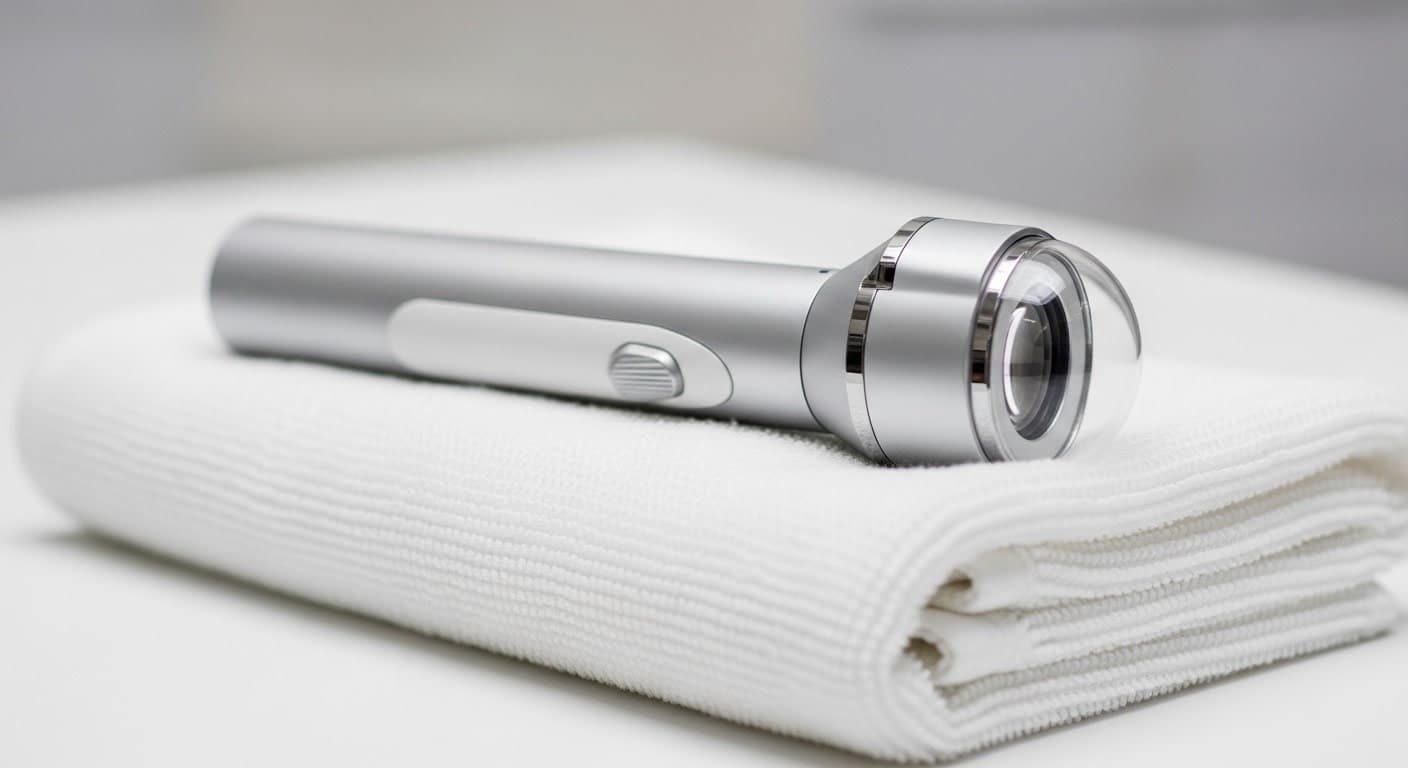
Trichoscopy is dermoscopy applied to the scalp and hair. A dermatologist places a handheld dermatoscope or video dermatoscope against your scalp and examines structures at 10x to 70x magnification. The procedure is non-invasive, painless, and takes roughly 10 to 15 minutes. It reveals details invisible to the naked eye: individual hair shaft diameters, follicular unit composition, perifollicular pigmentation, and scalp surface changes that map directly to specific diagnoses.
If you have been tracking your hair with photos and wondering what a clinical exam would add, trichoscopy is often the answer. It bridges the gap between what you can observe at home (macro density changes, recession patterns) and the microscopic detail a dermatologist needs to confirm a diagnosis and choose the right treatment. Pairing your BaldingAI photo history with trichoscopy findings gives both you and your clinician a more complete view of what is happening over time.
TL;DR
- Trichoscopy magnifies scalp structures at 10x-70x, revealing hair shaft diameter variation, follicular unit changes, and scalp surface signs.
- A 2011 systematic review validated trichoscopy sensitivity above 95% for differentiating androgenetic alopecia from other alopecias.
- The exam is painless, takes 10-15 minutes, and often eliminates the need for a scalp biopsy.
- Specific findings map to specific conditions: miniaturization for AGA, exclamation mark hairs for alopecia areata, normal diameter diversity for telogen effluvium.
- Home photo tracking captures macro-level changes between appointments. Trichoscopy captures micro-level detail during them.
Important
This article is educational and not medical advice. If you are worried about sudden shedding, scalp symptoms, or side effects, talk to a licensed clinician.
What the dermatoscope actually shows
At standard magnification, all you see is hair and scalp. Under trichoscopy, the dermatologist can distinguish terminal hairs (thick, pigmented, fully mature) from vellus hairs (thin, short, often unpigmented). They can count how many hairs emerge from each follicular unit, a critical metric since healthy scalps typically show 2-4 hairs per unit in most zones.
The dermatoscope also reveals perifollicular and interfollicular features: brown halos around follicles (peripilar signs), yellow dots where follicles have atrophied and filled with sebum, black dots where hairs have broken at the surface, and white dots indicating fibrotic follicular openings. Each of these findings narrows the differential diagnosis.
Androgenetic alopecia under the lens
The hallmark trichoscopic finding in androgenetic alopecia (AGA) is hair diameter diversity exceeding 20%. In a healthy scalp, terminal hairs are relatively uniform in thickness. In AGA, DHT-sensitive follicles progressively miniaturize, producing thinner and shorter hairs with each growth cycle. Under the dermatoscope, this creates a visible mix of thick and thin shafts emerging from the same area.
Dermatologists also look for single-hair follicular units replacing what should be multi-hair units. A follicular unit that once produced 3 terminal hairs may now show 1 terminal hair and 2 vellus hairs, or just 1 hair total. Peripilar signs (brown halos 1-2mm around follicular openings) appear frequently in AGA and correlate with perifollicular inflammation. These findings, taken together, can confirm AGA diagnosis without a biopsy in most cases.
Alopecia areata: a different trichoscopic fingerprint
Alopecia areata produces trichoscopic findings that look nothing like AGA. The signature feature is exclamation mark hairs: short, broken hairs that taper from a normal-width tip to a narrowed, fragile base. These hairs indicate active immune-mediated damage at the follicle level.
Yellow dots (round, yellowish structures within empty follicular openings) appear frequently in alopecia areata and represent keratinous material filling follicles that have stopped producing hair. Black dots, which are hairs fractured at the scalp surface, indicate recent hair breakage. Short regrowing hairs with tapered tips suggest the condition may be entering a recovery phase. This distinction matters clinically because AGA and alopecia areata require fundamentally different treatments.
Telogen effluvium: what trichoscopy rules out
Telogen effluvium (TE) is diffuse shedding triggered by a physiological stressor, and its trichoscopic appearance is notable for what it does not show. There is no miniaturization, no significant diameter diversity, no exclamation mark hairs, and no yellow dots. The scalp looks relatively normal under magnification, just with fewer hairs overall and a higher proportion of short regrowing hairs in the same growth phase.
This is exactly why trichoscopy matters for TE diagnosis. A person experiencing diffuse shedding may fear they have AGA, but trichoscopy can show that the hair shafts are uniform in diameter and the follicular units are intact. That distinction changes the treatment plan entirely: TE typically resolves once the trigger is addressed, while AGA requires ongoing intervention. If your dermatologist suspects TE, read more about the Norwood scale to understand where patterned loss differs.
The evidence base for trichoscopy accuracy
A 2011 systematic review by Rudnicka et al., published in Expert Review of Dermatology, validated trichoscopy sensitivity above 95% for differentiating AGA from other alopecias. This means that in the vast majority of cases, a trained clinician using trichoscopy alone can make the correct diagnosis without resorting to invasive procedures.
Trichoscopy does not replace scalp biopsy in every scenario. Scarring alopecias, cases with overlapping features, or unusual presentations may still require histopathological examination. But for the three most common causes of hair loss (AGA, alopecia areata, and telogen effluvium), trichoscopy provides fast, reliable differentiation in a single office visit.
What to expect during the exam
The exam itself is straightforward. You sit in a standard exam chair. The dermatologist parts your hair in several areas and places the dermatoscope lens against your scalp, typically with a small amount of immersion fluid or using a polarized light device that requires no fluid. They examine multiple zones: frontal hairline, mid-scalp, temporal areas, vertex, and occipital region (the back of the head serves as an internal control since it is usually spared in AGA).
No special preparation is needed. Arrive with your hair in its natural state (avoid heavy styling products or dry shampoo that could obscure the scalp surface). Some dermatologists capture digital images during the exam for longitudinal comparison at future visits. If yours does not, ask about it. These clinical images pair well with the photos you track at home through BaldingAI, giving both you and your clinician a more complete picture over time.
How home tracking complements clinical trichoscopy
Trichoscopy captures microscopic detail at a single point in time. Home tracking captures macro-level density trends over weeks and months. These two data streams answer different questions. Trichoscopy tells your dermatologist what is happening at the follicular level. Consistent photo tracking shows how fast it is progressing and whether treatment is changing the trajectory.
Tracking density changes between appointments with zone-specific photos means you arrive at each follow-up with documented evidence rather than subjective impressions. A dermatologist reviewing your trichoscopy findings alongside 3 months of tracked progress photos can make more confident treatment decisions than either data source alone would allow.
When to request trichoscopy
If you are seeing a dermatologist for hair loss for the first time, ask whether trichoscopy is part of the initial evaluation. Not all dermatologists perform it routinely, and some may use it only when the diagnosis is ambiguous. It is reasonable to request it explicitly, especially if you want a clear diagnosis before starting treatment.
Trichoscopy is also valuable at follow-up visits for monitoring treatment response. Changes in the vellus-to-terminal hair ratio, follicular unit composition, or diameter diversity over 6-12 months provide objective evidence of whether a treatment is working at the microscopic level, often before macro-level changes become visible in photos. Bring your visit preparation checklist and your tracking data for the most productive appointment possible.
Bottom line
Trichoscopy gives your dermatologist a microscopic view of what your follicles are doing right now. Your tracking photos show how the situation is evolving over time. Together, they form a complete diagnostic and monitoring toolkit.
Sources: Rudnicka et al., Expert Review of Dermatology (2011) and Journal of the American Academy of Dermatology, trichoscopy review.