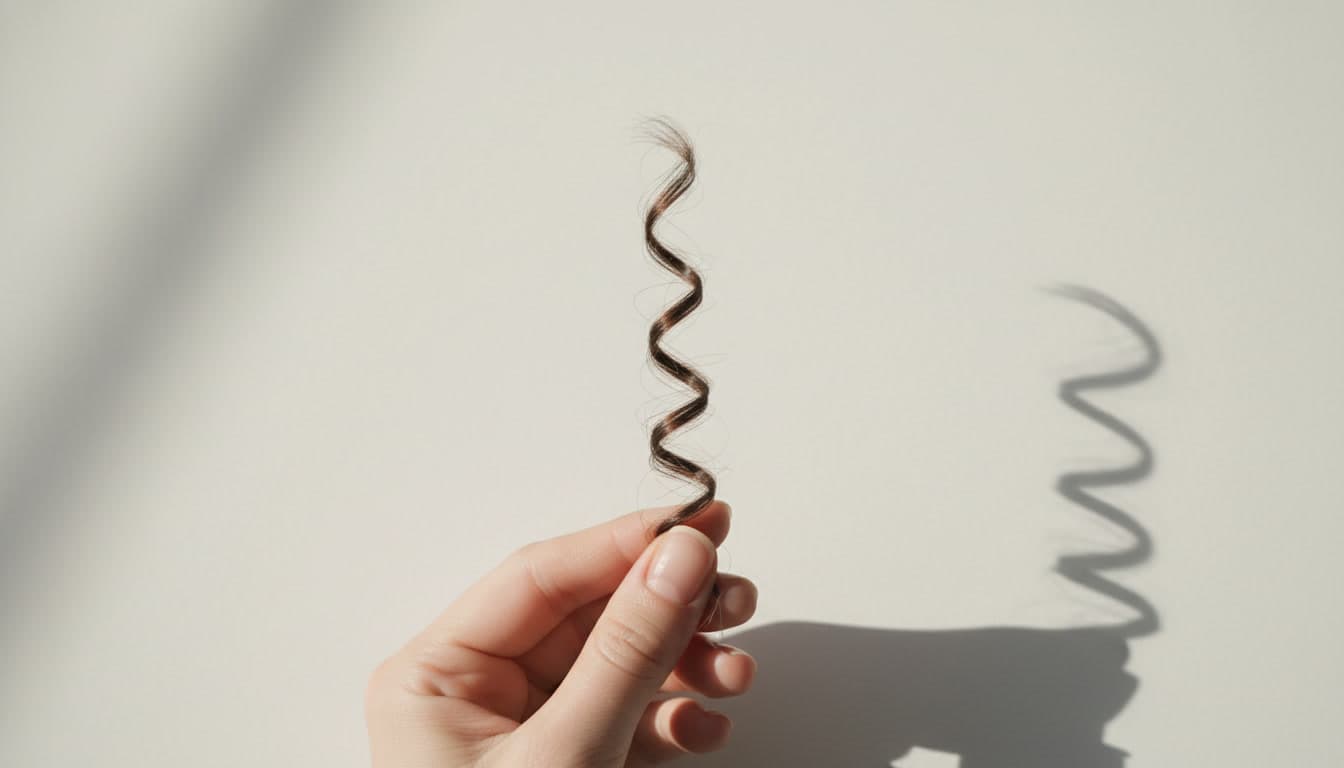
The hair pull test is one of the oldest and simplest clinical screening tools in dermatology. It does not diagnose anything on its own, but a well-performed pull test can flag active shedding, differentiate diffuse loss from patterned recession, and tell you whether something is worth bringing to a dermatologist this month versus next quarter. Done at home, it is a 60-second check that pairs naturally with photo tracking.
The problem with at-home pull tests is that almost everyone does them wrong. People test on freshly washed hair, pull too hard, or count wrong. This guide walks through the standardized protocol dermatologists use, what counts as a positive result, and exactly how to log it so the data is actually useful when you compare weeks side by side.
TL;DR
- The pull test grasps roughly 40-60 hairs near the scalp and applies firm, steady traction along the shaft.
- More than 10 percent of grasped hairs extracted is generally considered a positive result.
- Do not wash, brush, or vigorously style your hair for at least 24 hours before testing. Results are unreliable otherwise.
- Test five separate zones (front, both sides, vertex, occipital) so you can tell diffuse from patterned shedding.
- A single pull test is a snapshot. Trend across 4-8 weeks paired with photos is what gives you a decision-grade signal.
Important
This article is educational and not medical advice. If you are worried about sudden shedding, scalp symptoms, or side effects, talk to a licensed clinician.
What the pull test actually measures
The pull test measures the proportion of hairs currently in the telogen (resting) and exogen (shedding) phases that are loose enough to be extracted with gentle traction. In a healthy scalp, roughly 10-15 percent of follicles are in telogen at any moment, and only a small fraction of those are loose enough to release under traction. A positive pull test suggests that a higher-than-normal proportion of follicles are in active shedding, a hallmark of telogen effluvium or active patterned loss.
The test does not distinguish between causes. A positive pull test on the crown could indicate androgenetic alopecia, while a positive pull test that is uniform across the entire scalp is more characteristic of diffuse telogen effluvium. That is why testing multiple zones matters. See telogen effluvium vs male pattern baldness for the pattern differentiation framework.
How to perform the test correctly
Skip washing your hair for at least 24 hours before the test, and 48 hours if you can. Recently washed hair has already shed the loosest hairs in the drain, which produces falsely negative results. Avoid heavy brushing or aggressive styling in the same window for the same reason.
Stand in a well-lit room over a contrasting surface: a white countertop if your hair is dark, a dark towel if your hair is light. Gather approximately 40-60 hairs near the scalp between your thumb and index finger. Apply firm, steady traction along the full length of the shaft from root to tip. Do not yank. The motion should feel like a confident comb-through, not a tug. Count the hairs that come free into your hand.
Repeat the test in five anatomical zones: frontal hairline, both temporal regions, vertex (crown), and occipital (back of head). Log the count for each zone separately. If you are tracking by zone with the zone priority framework, the pull test gives you an additional data point that pairs with your weekly photos.
Interpreting your result
A negative pull test extracts 0-3 hairs from a 40-60 hair grasp. That is roughly under 6 percent and is within the expected range for a healthy scalp. A borderline result extracts 4-6 hairs (around 10 percent), which warrants repeat testing in 2-4 weeks before drawing conclusions. A positive result extracts more than 6 hairs (over 10 percent) and is considered consistent with active shedding.
Patterns matter as much as the absolute count. A positive result only at the crown and temples is more consistent with androgenetic alopecia. A positive result uniform across all five zones is more consistent with telogen effluvium. A focal positive result in one patch should prompt evaluation for alopecia areata. None of these are diagnoses. They are pattern hints for the dermatologist conversation.
How to log it alongside photo tracking
Run the pull test on the same day each week, immediately before your weekly photo session. Note three things in your log: the count per zone, the time since last wash, and any unusual styling or treatment changes in the previous 48 hours. Without those context variables, week-to-week comparison is unreliable.
Pair pull-test trends with the AI density score for the same zone. If your crown pull test is borderline positive and your crown density score is trending down across 4-8 weeks, that is convergent evidence worth acting on. If the pull test is positive but density is stable, the shedding may resolve on its own and warrants continued observation rather than panic.
Common questions
Can I do the pull test on wet hair?
No. Wet hair has different mechanical properties and the test becomes unreliable. Always test on dry hair that has not been washed for at least 24 hours.
How often should I repeat the pull test?
Weekly is reasonable if you are actively monitoring a suspected shedding episode. If your trend is stable, monthly is sufficient. Avoid daily testing. The data is noisy and repeated traction is not useful diagnostically.
Does a negative pull test mean I am not losing hair?
Not at all. The pull test only detects actively shedding hair. Slow miniaturization in androgenetic alopecia often produces negative pull tests because individual follicles are shrinking rather than shedding in waves. Photo and density tracking remain the primary evidence for that pattern of loss.
Next step
Run a standardized pull test across all five zones this week, immediately before your weekly photo capture. Log the counts. In four weeks, repeat. The comparison gives you something almost no one else has: trend data on active shedding paired with objective density scoring.
Sources: AAD: hair loss causes and evaluation | McDonald et al. (2017): Hair pull test as a diagnostic tool | Mubki et al. (2014): Evaluation and diagnosis of the hair loss patient.