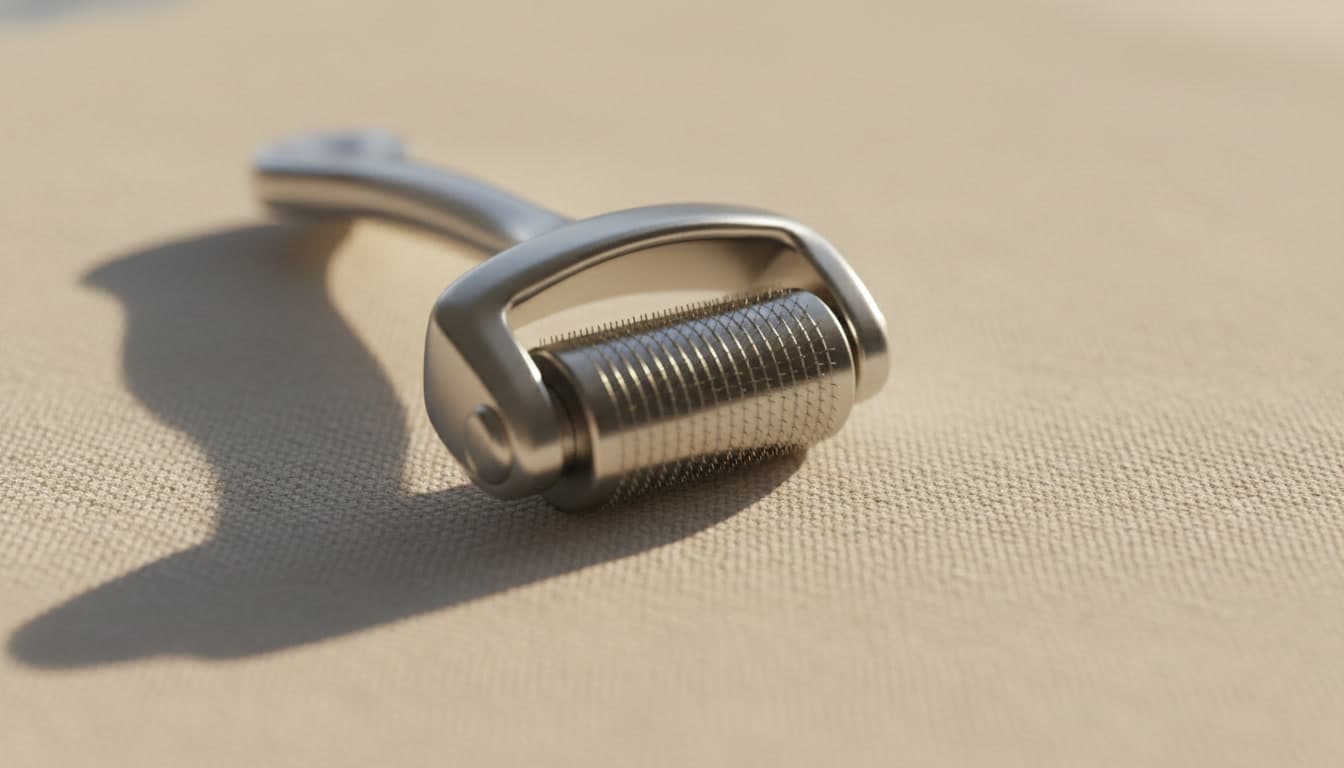
Needle length is the single most consequential choice when you microneedle the scalp for hair loss. It determines how deep the microchannels go, whether you reach the bulge region where follicle stem cells live, how much pain and bleeding to expect, and how much downtime you need between sessions. Pick the wrong length and you are either wasting effort on shallow passes or creating scarring risk with depth your home protocol cannot support.
The published research uses a fairly narrow band of needle lengths, and the consensus has shifted in the past decade. This guide breaks down what each length range does, where the clinical evidence lands, and how to pick a length you can actually sustain for the 16-24 weeks needed to evaluate a tracked density signal.
TL;DR
- 0.25-0.30 mm: cosmetic-only depth, useful for topical absorption but not for follicle stimulation. No evidence of hair density benefit at this length.
- 0.50 mm: the most common consumer length, reaches papillary dermis. Limited but suggestive evidence for adjunct use with minoxidil.
- 1.00-1.50 mm: the length used in the landmark Dhurat et al. (2013) trial. Strongest evidence base for density improvement combined with minoxidil.
- 2.00 mm and above: clinic-only depth. Home use at this length carries meaningful scarring and infection risk.
- Cadence matters as much as depth. Longer needles require longer recovery windows. Weekly is appropriate for 0.5 mm, biweekly or less for 1.5 mm.
Important
This article is educational and not medical advice. If you are worried about sudden shedding, scalp symptoms, or side effects, talk to a licensed clinician.
What needle length actually does in the scalp
Scalp tissue has a layered structure. The epidermis is roughly 0.1 mm thick. The papillary dermis extends to about 0.5 mm. The reticular dermis runs to roughly 1.5 mm, and the follicle bulge region, where the follicle stem cells responsible for regeneration sit, is around 1.0-1.5 mm deep depending on the individual. Hair follicles themselves extend deeper, into the subcutaneous tissue at 3-4 mm.
A 0.25 mm roller barely passes the epidermis. A 0.5 mm roller reaches the papillary dermis and triggers mild wound-healing signaling. A 1.0-1.5 mm device penetrates into the reticular dermis and reaches the bulge region, activating the Wnt/β-catenin and platelet-derived growth factor pathways that the clinical literature attributes to follicle stimulation.
The clinical evidence by length
1.5 mm: The most-cited study is Dhurat et al. (2013), which randomized 100 men to 5 percent minoxidil alone versus minoxidil plus weekly 1.5 mm dermarolling. At 12 weeks, the dermarolling group showed significantly greater hair count improvement. This is the foundation of the current 1.5 mm recommendation for AGA adjunct use.
1.0 mm: Smaller studies have shown benefit at 1.0 mm with similar weekly-to-biweekly cadence. Mechanistically sound for reaching the bulge region with less downtime than 1.5 mm.
0.5 mm: Sparse direct evidence for density improvement. Mostly used as a tolerability bridge for people who cannot manage 1.0-1.5 mm depth comfortably. Treat it as an unproven length until you have personally tracked a response.
0.25-0.30 mm: No meaningful evidence for hair density. Often marketed as enhancing topical penetration, but the density signal from this pathway is small relative to follicle bulge stimulation. See the 12-week microneedling tracking protocol for cadence and capture details.
Choosing your length
If you are using microneedling as a minoxidil adjunct and can tolerate the discomfort, 1.0-1.5 mm has the strongest evidence base. Start at 1.0 mm if you have never microneedled before, and consider 1.5 mm after 4-6 weeks of comfortable 1.0 mm sessions.
If you are sensitive to pain, have a bleeding disorder, are on anticoagulants, or have any active scalp condition (psoriasis, seborrheic dermatitis flares, folliculitis), do not microneedle until those are managed. See scalp psoriasis vs seborrheic dermatitis for differentiation if uncertain.
Cadence matching by length
Deeper needles require longer recovery windows because the wound-healing cascade takes longer to complete in the reticular dermis. Common cadence pairings: 0.5 mm once or twice weekly, 1.0 mm once weekly, 1.5 mm every 10-14 days. Going more frequently than your tissue can recover from interrupts the regenerative signaling rather than reinforcing it.
The most common failure mode is people switching to 1.5 mm and keeping a weekly cadence designed for 0.5 mm. The session pain spikes, recovery feels incomplete, and they quit before the protocol can produce a measurable density change. Pick a length and a cadence you can sustain for at least 16 weeks of tracking.
Common questions
Is a longer needle always better?
No. Beyond 1.5 mm the scarring and infection risk grows faster than the additional therapeutic benefit at home. Clinic-grade 2.0+ mm pen devices are not appropriate for unsupervised home use.
Should I apply minoxidil right after microneedling?
Most dermatologists recommend waiting 12-24 hours before applying topical minoxidil to microneedled scalp because absorption increases significantly through open microchannels, which can amplify irritation. The Dhurat protocol applied minoxidil on non-microneedling days.
How long until I see a density change from microneedling?
Most published protocols evaluated at 12 weeks. A realistic home tracking window is 16-24 weeks of consistent cadence before deciding whether the protocol is working for you. Earlier readings will be dominated by photo and lighting noise.
Next step
Capture a clean baseline density score across all zones before you start. Choose a needle length and cadence you can sustain for 16-24 weeks. Track weekly. At the 16-week mark, compare density trend lines rather than single weeks, and decide whether to continue, adjust cadence, or stop.
Sources: Dhurat et al. (2013): Microneedling and minoxidil for AGA | Microneedling plus minoxidil systematic review (2023) | AAD: hair loss treatment overview.