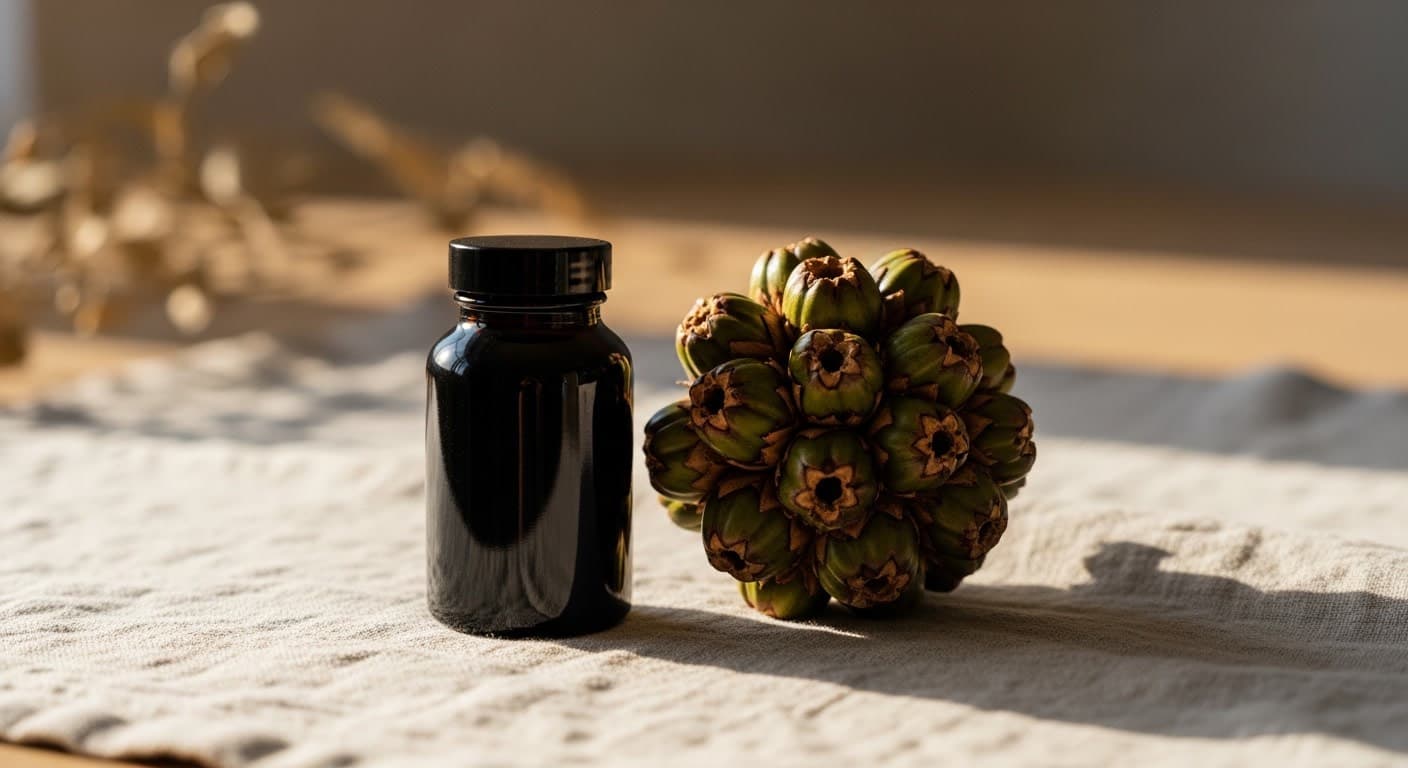
Saw palmetto (Serenoa repens) is the most popular natural supplement marketed for hair loss, and it targets the same enzyme that finasteride does: 5-alpha reductase. That shared mechanism makes it genuinely interesting, not just another herbal hand-wave. But the strength of the effect is meaningfully different, and the evidence base is thinner than what you will find for prescription treatments. Here is what the clinical data actually supports, how saw palmetto compares to finasteride, and how to track your response if you decide to try it. At this effect size, objective photo tracking through an app like BaldingAI is the only reliable way to tell if it is working.
TL;DR
- Saw palmetto inhibits 5-alpha reductase, the same enzyme finasteride targets, but reduces DHT by roughly 32% vs finasteride's 70%.
- A 2012 meta-analysis found 60% improvement rates vs placebo, with fewer side effects than finasteride.
- A 2020 systematic review confirmed modest benefit, but called the evidence moderate quality overall.
- Standard dose is 320mg daily of standardized extract. Not FDA-approved for hair loss.
- Track for at least six months before evaluating. Objective photo data is essential at this effect size.
Important
This article is educational and not medical advice. If you are worried about sudden shedding, scalp symptoms, or side effects, talk to a licensed clinician.
How does saw palmetto work for hair loss?
Saw palmetto extract contains a mixture of fatty acids (lauric acid, oleic acid, myristic acid) and phytosterols that inhibit both type I and type II isoforms of 5-alpha reductase. This is the enzyme that converts testosterone into dihydrotestosterone (DHT), the androgen directly responsible for follicle miniaturization in androgenetic alopecia.
The inhibition is real but partial. Studies measuring serum DHT levels in men taking saw palmetto show reductions of approximately 32%, compared to roughly 70% with finasteride 1mg. Saw palmetto also appears to block androgen receptor binding in some tissue types and has anti-inflammatory properties that may reduce perifollicular inflammation, a recognized contributor to hair loss progression.
The dual mechanism (DHT reduction plus anti-inflammatory action) is part of what makes saw palmetto interesting from a pharmacological standpoint, even if neither effect is as strong as its pharmaceutical counterpart.
What does the clinical evidence show?
The most cited analysis is Rossi et al. (2012), published in the Journal of Cutaneous and Aesthetic Surgery. This meta-analysis reviewed multiple studies of saw palmetto for androgenetic alopecia and found a 60% improvement rate in subjects receiving saw palmetto compared to placebo. The analysis noted that while the improvement was less dramatic than finasteride, the side-effect profile was significantly more favorable.
A 2020 systematic review by Evron et al., published in Complementary Therapies in Medicine, evaluated all available randomized controlled trials and observational studies of saw palmetto for hair loss. The review concluded that saw palmetto shows modest benefit over placebo, with fewer reported sexual side effects than finasteride. It also highlighted that most studies were small (under 100 participants), short (under 24 weeks), and used heterogeneous formulations, making direct comparison difficult.
One notable head-to-head trial (Comparato et al., 2012) randomized 100 men with androgenetic alopecia to either finasteride 1mg or saw palmetto 320mg daily for two years. Finasteride produced improvement in 68% of subjects vs 38% for saw palmetto. Both outperformed placebo, but finasteride was clearly more effective. The saw palmetto group reported fewer side effects.
How does saw palmetto compare to finasteride?
The comparison is straightforward in terms of efficacy: finasteride is stronger. It reduces scalp DHT by approximately 60 to 70%, has been studied in trials involving thousands of men over five-plus years, and is FDA-approved for male pattern hair loss. Saw palmetto reduces DHT by roughly 32%, has been studied in trials involving hundreds of men over shorter periods, and has no regulatory approval for hair loss.
The comparison shifts when you factor in side effects. Finasteride carries a well-documented risk of sexual side effects (decreased libido, erectile dysfunction) in roughly 2 to 4% of users, and a small subset report persistent symptoms after discontinuation. Saw palmetto has not shown these effects at statistically significant rates in any published trial. For men who are concerned about finasteride side effects or who have experienced them, saw palmetto represents a weaker-but-tolerable alternative.
If you are weighing the decision to start finasteride, saw palmetto can serve as a stepping stone. Some men try saw palmetto first, track the response for six months, and escalate to finasteride if the natural approach is insufficient. That is a reasonable strategy as long as you are tracking objectively.
What is the correct dosage?
The standard dose used in clinical trials is 320mg per day of standardized saw palmetto extract, typically containing 85 to 95% fatty acids and sterols. This is the dose from both the Rossi meta-analysis and the Comparato head-to-head trial. Most commercially available supplements follow this dosing.
Formulation matters. Liposterolic extracts (oil-based, supercritical CO2 extraction) have the best bioavailability and are the formulation used in most positive studies. Dried berry powder capsules are cheaper but deliver lower concentrations of the active fatty acids. If you are buying a supplement, look for “liposterolic extract” or “supercritical extract” on the label, not just “saw palmetto berry.”
Topical saw palmetto formulations also exist, often combined with other botanicals. A 2020 study by Wessagowit et al. tested a topical serum containing 0.025% saw palmetto with other plant extracts and found reduced shedding and improved hair density after 24 weeks. Topical application avoids systemic absorption entirely, which appeals to some users, but the evidence base for topical saw palmetto is even thinner than for oral.
Can you combine saw palmetto with other treatments?
Many people stack saw palmetto with other natural approaches. Pumpkin seed oil (400mg daily) showed a 40% improvement in hair count in a 2014 randomized trial by Cho et al. Rosemary oil has its own evidence for topical DHT reduction. Some men combine all three in a “natural stack” before considering pharmaceuticals.
If you are already on finasteride, adding saw palmetto is unlikely to provide meaningful additional DHT reduction, since finasteride already suppresses the enzyme more completely. The combination has not been studied in any published trial. The more logical pairing is saw palmetto plus minoxidil, since they work through entirely different mechanisms.
Whichever combination you choose, the tracking principle remains the same: start one treatment at a time so you can attribute changes accurately. Stacking everything at once means you will never know what is actually working.
What about side effects?
Saw palmetto is generally well-tolerated at 320mg daily. The most commonly reported side effects in clinical trials are mild gastrointestinal symptoms: nausea, abdominal discomfort, and diarrhea. These occur in a small minority of users and typically resolve within the first two weeks.
Saw palmetto can interact with anticoagulant and antiplatelet medications because of its fatty acid profile. If you are taking blood thinners, consult your doctor before starting. Pregnant women should avoid saw palmetto entirely due to its antiandrogenic activity.
The key takeaway on safety: the 2020 Evron systematic review specifically noted that saw palmetto's side-effect profile was significantly more favorable than finasteride's, which is the primary reason many men consider it as a first-line natural option.
How to track your saw palmetto response
Because saw palmetto's effect size is smaller than finasteride's, objective tracking is not optional. Subtle improvements are easy to miss in the mirror and easy to imagine when you want them to be there. You need measurable data points over a long timeline.
Start with a baseline scan on day one: hairline, temples, crown, and part line. Use consistent lighting and angle every time. BaldingAI standardizes these variables so each scan produces a comparable density score. Scan every one to two weeks and log your dosage, brand, and any co-treatments alongside each photo.
Six months is the minimum evaluation window. The hair growth cycle takes time to respond to hormonal changes, and DHT-mediated miniaturization reverses slowly. At the six-month mark, review your trend line. Stable density (no decline) is a reasonable outcome for a natural DHT blocker. Visible improvement in density scores is a strong positive signal. If your density is still declining at the same rate, saw palmetto is probably not providing sufficient DHT suppression for your degree of loss.
That data becomes especially valuable if you later decide to escalate to finasteride. You will have a documented natural-treatment baseline, which helps your clinician understand how your hair responds to partial DHT reduction before introducing a stronger intervention.
The bottom line
Saw palmetto is not a myth and not a miracle. It targets the right enzyme, it has clinical evidence showing modest benefit over placebo, and it has a favorable side-effect profile. It is also not as strong as finasteride by a significant margin. For men with mild thinning who prefer to start with a natural approach, 320mg of standardized extract daily is a defensible choice.
The deciding factor is not which supplement you choose. It is whether you track the outcome with enough rigor to know if it is working. At saw palmetto's effect size, the difference between “working” and “not working” can be subtle enough to miss without objective data. Six months of consistent scans will give you a clear answer.
Sources: Rossi et al. 2012, Journal of Cutaneous and Aesthetic Surgery, Evron et al. 2020, Complementary Therapies in Medicine.